This task for reading was about making prediction. Predictions are educated guesses. The education comes from our prior knowledge and the clues from the books.
To make our first predictions we only looked at the title and pictures on the front page. We predicted what text type the story was, what the story was about and sentences we think might be in the book.
After that we read 2-3 paragraphs and made more predictions about other things. We made 3-6 other predictions.
After getting our predictions checked, we wrote on the next column whether we were correct or incorrect. If we were incorrect we wrote what really happened.
Making predictions can help with understanding a text.
LI: To predict events to come.

Tuesday, 9 June 2020

Friday, 5 June 2020
Reading Large Numbers
The task for maths was about saying large numbers.
Reading large numbers can be difficult when they are in number forms.
To read 834 237 452, first you need to read the millions which are the first set of numbers. They are eight hundred and thirty four million.
After that you need to read the thousands which are the second set of numbers. They are two hundred and thirty seven thousand.
Lastly, you need to read the ones which are the last set of numbers. They are four hundred and fifty seven.
When you put the steps together it will be: eight hundred and thiry four million, two hundred and thirty seven thousand and four hundred and fifty seven.
LI: To read and recall numbers greater than one hundred.
Reading large numbers can be difficult when they are in number forms.
To read 834 237 452, first you need to read the millions which are the first set of numbers. They are eight hundred and thirty four million.
After that you need to read the thousands which are the second set of numbers. They are two hundred and thirty seven thousand.
Lastly, you need to read the ones which are the last set of numbers. They are four hundred and fifty seven.
When you put the steps together it will be: eight hundred and thiry four million, two hundred and thirty seven thousand and four hundred and fifty seven.
LI: To read and recall numbers greater than one hundred.
Homophones
The task for writing was about homophones. Homophones are words that sound the same, have different meanings and are spelt differently.
First, we used a Google Sheet which included 10 homophones. Then we chose three homophones and used them to create an infographic.
In the infographic we wrote down the meaning of the homophones and inserted a picture to go with it.
LI: To investigate homophones.
First, we used a Google Sheet which included 10 homophones. Then we chose three homophones and used them to create an infographic.
In the infographic we wrote down the meaning of the homophones and inserted a picture to go with it.
LI: To investigate homophones.
Plurals | Describing Objects
The task for writing was about plurals. Plurals are more than one thing. They have rules and exceptions.
We were describing objects with plurals. There were twelve pictures that we each described. Our description included an adjective and a noun that could be plural.
There was a no-no list which included words that we couldn't use (because they were boring or simple). Some of the list included: long, good, little, man, woman, insect and etc.
LI: To describe objects using specific and interesting nouns and adjectives.
We were describing objects with plurals. There were twelve pictures that we each described. Our description included an adjective and a noun that could be plural.
There was a no-no list which included words that we couldn't use (because they were boring or simple). Some of the list included: long, good, little, man, woman, insect and etc.
LI: To describe objects using specific and interesting nouns and adjectives.
Thursday, 4 June 2020
Properties of Light
The task for inquiry was to observe/investigate to the properties of light.
We were experimenting the properties of light. In a Google Document we were recording the experiment's result and writing the observations and hypothesis. A hypothesis is a starting thought for more investigation. Property is a characteristic that something owns.
In the second column we put the evidence in. The evidence was the photo that we took of the experiment.
After that we wrote the properties of light in the hypothesis column. We found many properties but one is that: light can travel through transparent objects.
LI: To observe the properties of light.
We were experimenting the properties of light. In a Google Document we were recording the experiment's result and writing the observations and hypothesis. A hypothesis is a starting thought for more investigation. Property is a characteristic that something owns.
In the second column we put the evidence in. The evidence was the photo that we took of the experiment.
After that we wrote the properties of light in the hypothesis column. We found many properties but one is that: light can travel through transparent objects.
LI: To observe the properties of light.
Measurement | Weight
The task for maths was to measure the weight of three things in the classroom using standard forms of measurement. Weight is how heavy something is.
We first wrote down the standard forms of measuring weight and they are: tonnes (T), kilograms (kg) and grams (g). The tools to measure these are scales.
After that we estimated the weight of the three objects we chose. Estimation is an educated guess using your prior knowledge. After estimating we measured the weight with three different scales. We used a balancing scale, a hanging scale and glass scale.
Lastly, we converted the forms of measurement up and down a unit. To convert grams to kilograms you need to divide by 1000 and then divide by 1000 again to get to tonnes.
LI: To explore standard forms of weight.
We first wrote down the standard forms of measuring weight and they are: tonnes (T), kilograms (kg) and grams (g). The tools to measure these are scales.
After that we estimated the weight of the three objects we chose. Estimation is an educated guess using your prior knowledge. After estimating we measured the weight with three different scales. We used a balancing scale, a hanging scale and glass scale.
Lastly, we converted the forms of measurement up and down a unit. To convert grams to kilograms you need to divide by 1000 and then divide by 1000 again to get to tonnes.
LI: To explore standard forms of weight.
Wednesday, 3 June 2020
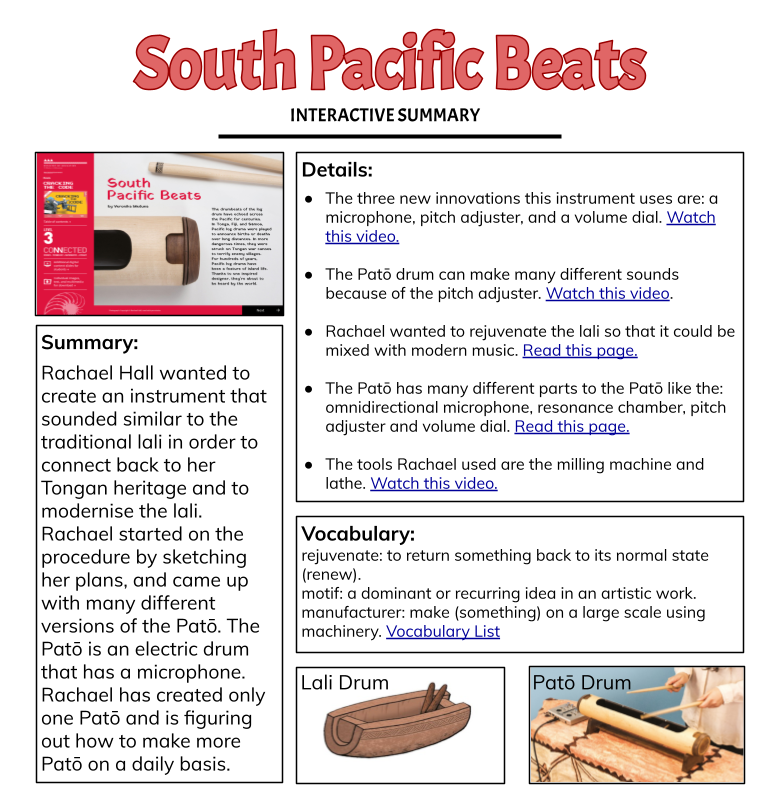
South Pacific Beats
The task for reading was to create an interactive summary about the article South Pacific Beats.
The first thing we did was to learn the reading strategies that helped us understand the text better. The reading strategies we practised were: visualising, prior knowledge, skimming and scanning.
Visualising is the process of understanding some of the text and then drawing what you understand. Prior knowledge is when you already know things about the topic of the text. Skimming is when you read a text quickly to understand the general idea of the book and scanning is when you look for specific information in a text.
After that we looked at the vocabulary. Vocabulary is the words that someone (like yourself) doesn't understand the meaning of. Some people might not know the meaning of: 'obfuscate'. So they would tell people the meaning of the word. For example:
obfuscate - meaning: something made unclear or confusing.
LI: To create an interactive summary of the article South Pacific Beats.
The first thing we did was to learn the reading strategies that helped us understand the text better. The reading strategies we practised were: visualising, prior knowledge, skimming and scanning.
Visualising is the process of understanding some of the text and then drawing what you understand. Prior knowledge is when you already know things about the topic of the text. Skimming is when you read a text quickly to understand the general idea of the book and scanning is when you look for specific information in a text.
After that we looked at the vocabulary. Vocabulary is the words that someone (like yourself) doesn't understand the meaning of. Some people might not know the meaning of: 'obfuscate'. So they would tell people the meaning of the word. For example:
obfuscate - meaning: something made unclear or confusing.
LI: To create an interactive summary of the article South Pacific Beats.
Subscribe to:
Posts (Atom)