Mr Wong's learning for writing was about nouns. All objects have a name given to it, these are called 'nouns'. There are three different nouns and they are: noun, proper noun and pronoun.
We first learned the definition of the three types of nouns. A noun is the name given to an object. A proper noun is the name given to a unique (unique definition: only one version of it) thing. A pronoun is the general name given to an object, person or group of people.
Afer that we learned about how proper nouns need to have a capital letter at the beginning of the word. Pronouns and nouns need to have a lowercase letter at the beginning of the word.
LI: To learn about nouns, proper nouns and pronouns.

Friday, 22 May 2020

Scanning
Mr Wong's learning for reading was about the reading strategy scanning. Scanning is a reading strategy where you look for specific information in a text to understand the text.
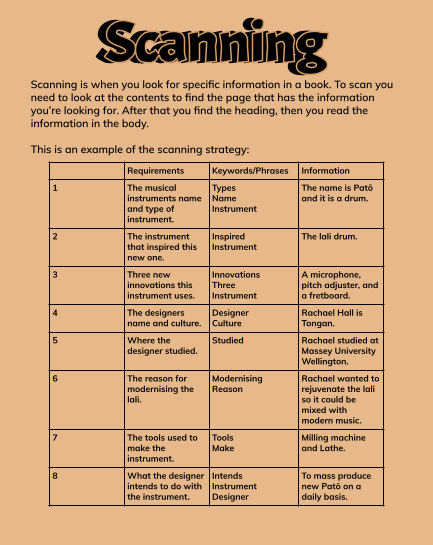
We created a list of keywords on a Google Document to guide us. There were eight requirements that we answered.
To scan we first looked at the contents page in the book, our text didn't have a contents page, so we moved to the next step.
Next we looked at the heading. If the heading contained one of our keywords we noted, we started reading the information in the body.
LI: To scan the article South Pacific Beats.
Wednesday, 13 May 2020
Narration | Reported Speech | Writing
Mr Wong's task for writing was about narration. Narration is telling people what is happening in a situation. We narrated a scene with reported speech. Reported speech is when you tell someone what someone else has said.
In reported speech we need to use third person like; people's names, he, she, they and ect.
We first wrote who was speaking with a dialogue word. Some example's of dialogue words are: 'shouted', 'stated', 'asked', 'questioned', and many more.
Next we wrote what the person was saying but without quotation marks (""). We made sure to change all the first and second person words to third person words. Example: Debbie shouted at her kids to brush their teeth.
LI: To narrate a scene using reported speech.
In reported speech we need to use third person like; people's names, he, she, they and ect.
We first wrote who was speaking with a dialogue word. Some example's of dialogue words are: 'shouted', 'stated', 'asked', 'questioned', and many more.
Next we wrote what the person was saying but without quotation marks (""). We made sure to change all the first and second person words to third person words. Example: Debbie shouted at her kids to brush their teeth.
LI: To narrate a scene using reported speech.
Wednesday, 22 April 2020
Conversations | Writing
Mr Wong's writing task was about conversations using direct speech. Direct speech is exactly what someone has said.
The task we were given, was to create a dialogic conversation using direct speech.
When you start a conversation each speaker needs their own line. This is to know who is speaking. Instead of using 'said' you can use 'stated', 'growled', 'shouted' and many more.
LI: To write conversations.
The task we were given, was to create a dialogic conversation using direct speech.
When you start a conversation each speaker needs their own line. This is to know who is speaking. Instead of using 'said' you can use 'stated', 'growled', 'shouted' and many more.
LI: To write conversations.
Skimming | Patō | Reading
Mr Wong's reading task was about skimming the 'South Pacific Beats' article. The article was about the Patō drum. The Patō is a modernised electric drum with a microphone that is similar to the lali. It was made by Racheal Hall.
The task we were given, was to create a brief summary of each page for the article 'South Pacific Beats'. After doing that, we made another summary but for the whole article. We made the summaries by skimming the article.
You can read the first (topic) sentence of each paragraph to know what the paragraph is about. To identify paragraphs, they usually have spaces between each paragraph or an indent to the first sentence. For example:
The drumbeats of the log drum have been a very traditional note/sound in the Pacific for centuries.
LI: To skim the article South Pasific Beats for a general understanding.
Buffed Vocabulary | Reading
Mr Wong's task for reading was to create a buffed vocabulary list. The task we were given was, in a group we chose two words we don't know the meaning of.
We wrote what we thought the word meant in the 'Kid's definition' box. After that we found kid's dictionary meaning and put that into the 'Dictionary definition' box along with the link. Then we made a sentence example that has an example of what the word could be about.
After that we found a picture and video that shows the word we picked. We did this with our other word we picked aswell. Mr Wong explained that the word needed to be in lowercase. This is so we don't write the word with a capital letter in a sentence. Correct: The spa rejuvenated me. Incorrect: The spa Rejuvenated me.
LI: To expand vocabulary.
We wrote what we thought the word meant in the 'Kid's definition' box. After that we found kid's dictionary meaning and put that into the 'Dictionary definition' box along with the link. Then we made a sentence example that has an example of what the word could be about.
After that we found a picture and video that shows the word we picked. We did this with our other word we picked aswell. Mr Wong explained that the word needed to be in lowercase. This is so we don't write the word with a capital letter in a sentence. Correct: The spa rejuvenated me. Incorrect: The spa Rejuvenated me.
LI: To expand vocabulary.
Timestable Patterns | Maths
Mr Ogilvie's maths task was about timetable patterns. The task we were given was to find out the pattern that the six timetables create.
We first find out how many blocks each turn would be. To do this we multiply by six. 6 x 1 = 6, which means the first line has to be six cubes long. 6 x 2 = 12, but 1 + 2 = 3, so the next line is three cubes long. 6 x 3 = 18 and 1 + 8 = 9, therefore the line is nine cubes long. While doing this, we need to remember that each line turns clockwise.
Eventually, the last line would lead back to were the first line was. This is because all patterns return to where it first started.
LI: To identify patterns in our times tables.

We first find out how many blocks each turn would be. To do this we multiply by six. 6 x 1 = 6, which means the first line has to be six cubes long. 6 x 2 = 12, but 1 + 2 = 3, so the next line is three cubes long. 6 x 3 = 18 and 1 + 8 = 9, therefore the line is nine cubes long. While doing this, we need to remember that each line turns clockwise.
Eventually, the last line would lead back to were the first line was. This is because all patterns return to where it first started.
LI: To identify patterns in our times tables.
Subscribe to:
Posts (Atom)